Facts checked 18 September 2026
We periodically re-check the facts on this page against confirmed sources. Things change fast in Japan: resorts, restaurants, runs and rental shops open, close and rename, so this is the date we last verified the claims here. This does not guarantee that every fact is accurate, but we make our best effort to keep them up to date, drawing on official sources such as the ski resort's own website.
Asahikawa: the city base for Kamui, Pippu, Asahidake and Kurodake

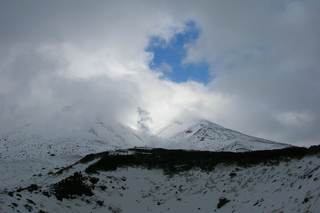
Image: "初冬の旭岳" (Mt. Asahidake of the early winter) by pakku, via Wikimedia Commons, CC BY 3.0 · Image credits
Asahikawa is Hokkaido's second city, a real working city on the Kamikawa Basin rather than a resort town that grew up around a lift line, and it happens to sit within reach of four ski areas that have almost nothing in common with each other. Kamui Ski Links, half an hour away, is a proper resort with deep, reliable snow and a quiet reputation. Pippu is a small, town-run local hill. Asahidake is a ropeway up Hokkaido's highest peak with barely a marked run in sight, pure backcountry above the treeline. Kurodake, further out again, pairs a ropeway with a chairlift above the hot-spring town of Sounkyo Onsen. None of the four are lift-linked, none are within easy walking distance of each other, and basing yourself in Asahikawa rather than at any one of them is what makes rotating between all four practical.
Major ski areas within range of Asahikawa3
A ropeway up Hokkaido's highest peak in Daisetsuzan National Park, mostly backcountry and off-piste, minimal lift infrastructure. No guide yet.
A resort above Asahikawa with a reputation for deep, reliable snow and few crowds, even in peak season. Read the guide
A small resort near Asahikawa, known for wide, gentle groomed runs. No guide yet.
Other reachable ski areas6
Plan a trip
- Get there
- Fly direct to Asahikawa Airport from Tokyo Haneda or Nagoya, or the JR Kamui/Lilac limited express from Sapporo, around 1h20.
- Then
- A rental car reaches all four comfortably; without one, lean on the OMO7 hotel's own ski shuttles and Pippu's free station bus.
- Stay
- Asahikawa city for Kamui, Pippu and Asahidake; add a night in Sounkyo Onsen itself for Kurodake.
- Combine
- Kamui Ski Links (30 min), Pippu (35–40 min), Asahidake (about 1h), Kurodake (1–1.5h).
- Time
- A week covers all four with a rest day for the city itself, ramen and the zoo included.
Why base in the city at all
None of the four resorts here are big enough, on their own, to justify building a trip around a single mountain hotel the way Niseko or Kiroro can. What Asahikawa offers instead is a genuine city: Asahikawa Ramen, a soy-based, pork-rich broth with a layer of oil on top that keeps it hot in the cold, has its own dedicated food court in Ramen Village; the Asahiyama Zoo is routinely rated one of the best in Japan for its "behavioural exhibits," showing animals moving rather than penned static; and the city has a long-standing furniture and woodworking industry with its own design centre open to visitors. It is also, by reputation and by the record books, seriously cold: Japan's official record low, -41.0°C, was recorded here in 1902, so pack accordingly. Hoshino Resorts leans into the ski-base role directly with its OMO7 Asahikawa hotel, which runs its own daily winter shuttle buses out to Kamui, Asahidake and Pippu and keeps live snow-condition cameras from several nearby ski areas at its in-house "OMO Base": a purpose-built ski hotel inside a real working city, an unusual combination in Japan.
The four resorts within reach
Kamui Ski Links, about 30 minutes from the city, is the closest and the most complete: six lifts, including one gondola, serving 25 courses over roughly 600m of vertical, with a reputation for deep, reliable snow and few crowds even in peak season. Pippu, 35–40 minutes northeast, is smaller and genuinely local: nine courses over around 340m of vertical, a free shuttle bus from Pippu Station, and an on-site onsen bath rather than any resort village. Sources disagree on its exact lift count, so treat it as a small, honest hill rather than a headline destination.
Asahidake, about an hour out, is the standout: a ropeway climbing Mount Asahidake, at 2,291m Hokkaido's highest peak, inside Daisetsuzan National Park, Japan's largest. It is reportedly the only ropeway in the country that runs entirely above the treeline, lifting around 500m of vertical to a viewpoint rather than a ski area: there is barely a marked run, and this is unpatrolled backcountry with no avalanche control. It rewards experienced off-piste skiers with a guide; turning up without either gets you the view, not skiable terrain. Kurodake, considerably further out at 1–1.5 hours, pairs a ropeway with a chairlift above it for around 850m of combined vertical, noticeably more built out than Asahidake, with at least one marked run and a base right inside the hot-spring town of Sounkyo Onsen. It is also reported as typically the earliest ski area in Hokkaido to open on natural snow each year, with no artificial snowmaking.
Live prices and availability from Booking.com, Airbnb, Expedia and others, via Stay22. We earn a commission on bookings made through the map, at no extra cost to you; it has no bearing on what is written above.
Getting there: fly, don't count on the train
There is no Shinkansen station in Asahikawa, and none is planned to reach it: the Hokkaido Shinkansen extension under construction goes only as far as Sapporo. For most visitors flying into Japan, the honest recommendation is to fly directly into Asahikawa Airport, which has scheduled service from Tokyo Haneda and Nagoya Centrair, with seasonal links to Osaka. Routing through Tokyo by rail instead means a Shinkansen to Shin-Hakodate-Hokuto, a further limited-express leg on to Sapporo, and then the JR Kamui or Lilac limited express on to Asahikawa: a genuinely long journey, in the region of ten hours all in. If you are already in Hokkaido, that last leg on its own, the Kamui or Lilac from Sapporo, is a realistic and pleasant way in: around 1h20 to 1h25, with trains roughly every 30 minutes. Driving from New Chitose Airport or Sapporo covers similar ground in around 1.5 to 2 hours.
Kurodake and Sounkyo Onsen: worth an overnight
Kamui, Pippu and Asahidake are all comfortable day trips from an Asahikawa city base. Kurodake is the exception: at 65–77km and up to an hour and a half each way, it is a long way to drive before first lift and a long way back after a full day on snow. Sounkyo Onsen, the hot-spring town at the ropeway's base, is a proper destination in its own right rather than just a car park: most of its ryokans have their own indoor and outdoor baths, and the town runs its own Ice Fall Festival most winters, roughly thirty illuminated ice sculptures through late January to early March. Given Kurodake's reputation for opening earliest of any Hokkaido ski area on natural snow, staying over near the ropeway rather than driving up mid-morning is the better way to catch it.
That forecast is for Asahikawa city itself; Asahidake and Kurodake both sit well above the valley floor and will run colder and snowier than the city number suggests.
Who this doesn't suit
If you want one resort with a proper village at its base, ski-in ski-out and nothing else to arrange, none of these four will give you that on their own: Kamui comes closest, but even it has no real village. Asahikawa suits travellers happy to drive each morning in exchange for a genuine Japanese city each evening, riders who want a serious backcountry objective at Asahidake with a guide booked, and anyone drawn to four distinctly different mountains over a rotation of similar-feeling resorts.
Need to know
- Getting there
- Fly direct to Asahikawa Airport (Haneda, Nagoya, seasonal Osaka), or JR Kamui/Lilac limited express from Sapporo (about 1h20–1h25). The Tokyo rail route runs to around ten hours; flying is the better option for most visitors.
- Getting around
- A rental car reaches all four; the OMO7 Asahikawa hotel runs its own winter shuttles to Kamui, Asahidake and Pippu, and Pippu also has a free shuttle from its own station.
- In range
- Kamui Ski Links (30 min); Pippu (35–40 min); Asahidake Ropeway (about 1h); Kurodake Ropeway, above Sounkyo Onsen (1–1.5h).
- Lift passes
- Bought separately at each; Asahidake and Kurodake are sightseeing/access ropeways rather than conventional lift-ticket resorts.
- Where to stay
- Asahikawa city for Kamui, Pippu and Asahidake; a night in Sounkyo Onsen itself for Kurodake rather than a daily commute.
- Best for
- Travellers who want a real city base and four distinctly different mountains, including a genuine above-treeline backcountry objective at Asahidake, rather than one resort's village.
Check each resort's official site for current lift, pass and opening information. Asahidake and Kurodake are unpatrolled, ungroomed terrain beyond their marked areas: a guide and avalanche safety equipment are strongly recommended.
No Asahikawa, Kamui, Pippu, Asahidake or Kurodake videos yet.