Facts checked 18 September 2026
We periodically re-check the facts on this page against confirmed sources. Things change fast in Japan: resorts, restaurants, runs and rental shops open, close and rename, so this is the date we last verified the claims here. This does not guarantee that every fact is accurate, but we make our best effort to keep them up to date, drawing on official sources such as the ski resort's own website.
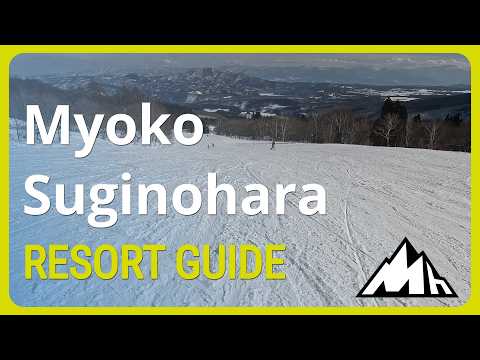
Myoko Suginohara: one of Japan's longest ski runs

Photo: uka0310, via Wikimedia Commons (CC BY 2.0) · Image credits
Suginohara's whole reputation rests on one number: 1,124 metres of vertical, dropped over a run that stretches roughly 8.5km from the summit gondola station down to the base, frequently cited as the longest ski run in Japan. It's a genuinely rare thing to ski top to bottom without a lift break, and it's the reason people who'd otherwise never single out a Myoko resort by name know this one. The mountain around that run, though, is a gentler proposition than the vertical number suggests: mostly wide, cruiser-pitched terrain built for distance rather than steepness, with a couple of short, named steep pitches and a terrain park for anyone who wants more than a long groomed descent.
Plan a trip
- Get there
- Hokuriku Shinkansen Tokyo to Joetsu-Myoko, about 1h50, then the Myoko Kogen Liner shuttle bus via Arai roadside station, 30–45 minutes.
- Stay
- Right at the base in Suginosawa village, or base yourself in Akakura and treat Suginohara as a day trip.
- Combine
- Suginohara has its own standalone lift ticket, or is bundled into the Mt. Myoko 1-Day Pass and the wider Snow Chaser Pass.
- Character
- A cruiser mountain built around one very long run, not a steeps mountain, though it does have two named 38° pitches and a terrain park.
- Time
- A day is enough to ride the long run a few times; it works well as one stop inside a wider Myoko trip based in Akakura.
The mountain
The Suginohara Gondola runs roughly 3km up to the 1,500m summit, taking around 18 minutes, and from there the long run heads down the full 1,124m of vertical to the base at Suginosawa. Sources differ slightly on the exact lift and trail count, anywhere from four to six lifts and sixteen to seventeen marked trails depending on who's counting, so treat any single figure as approximate rather than gospel. What's consistent across every source is the terrain split: roughly 40% beginner, 40% intermediate and 20% advanced, making this a genuinely cruiser-weighted mountain rather than a steeps destination, despite having one of the biggest single-resort drops in the country.
The exceptions to that cruiser character are two named runs, Super Mogul and Super Giant, both of which hit a maximum pitch of around 38°, the steepest terrain on the mountain, though they read more as short "event" runs than as the character of the place as a whole. There's ungroomed powder runs near the summit, topped up by Myoko's regular snowfall, and off-piste and tree skiing concentrated up near the top lift, though skiing under chairlifts and ducking ropes is explicitly against the rules here, with pass confiscation for anyone who does. It's boundary-permitted powder terrain rather than an anything-goes mountain. The "Sugi" terrain park adds a freestyle option the more traditional resorts in the wider Myoko cluster don't really have. There's no night skiing at Suginohara: Akakura Onsen, its neighbour across the wider Myoko Kogen area, is the one resort in the group that runs lifts after dark.
Suginohara is part of the wider Myoko Kogen area, whose base town Akakura is covered in full here: Suginohara is the one resort of that cluster that isn't lift-linked to anything else, sitting on its own in the hamlet of Suginosawa rather than in Akakura town itself.
Snow
Suginohara sits within the same very snowy Myoko Kogen belt as its neighbours, and the region-wide figures apply here too: roughly 5–12m of snowfall across a typical season is a safe, rounded claim for the area. Suginohara's own seasonal average is put at closer to 13m a year, towards the higher end of that range. Whichever figure you use, this is deep, reliable snow country by any standard.
Getting there
The nearest Shinkansen stop is Joetsu-Myoko on the Hokuriku line, about 1h50 from Tokyo, not the separate, local-rail-only Myoko-Kogen Station it's easy to confuse it with. From Joetsu-Myoko's east exit, the "Myoko Kogen Liner" shuttle bus runs through Akakura Onsen, Akakura Kanko and Landmark Myoko Kogen to Suginohara via Arai roadside station, taking 30–45 minutes, though there are only around two round trips a day, so it suits an arrival that lines up with the timetable rather than a spontaneous one. Driving from Tokyo is roughly 285km and 3.5–4 hours; winter tyres are assumed either way.
Lift pass
Unlike most of the smaller resorts scattered around Myoko Kogen, Suginohara sells its own standalone day ticket rather than requiring a multi-resort pass, priced at around ¥8,000 for a 1-day adult ticket at the gate, with cheaper 4-hour and advance-purchase online options available. It's also included on the Mt. Myoko 1-Day Lift Pass, which bundles Suginohara with Akakura Onsen, Akakura Kanko and Ikenotaira on one ticket, and on the wider Snow Chaser Lift Pass, a multi-resort ticket that includes Suginohara alongside several other Myoko-area resorts, though exactly which resorts that pass covers varies between sources, so it's worth checking current coverage directly before buying rather than assuming a fixed resort list. In practice, most visitors either buy Suginohara's own standalone ticket for a dedicated day here, or are already on one of the multi-resort passes as part of a broader Myoko trip based in Akakura.
Where to stay
Suginohara isn't a pure day-visit resort: there's a small, genuine base-area lodging cluster right at the lifts, in what's known locally as Suginosawa or Suginozawa village. Red Fox Lodge is a newly renovated lodge-style property directly at the base, with family and bunk rooms; Sugi Chalet is a private ski-in, ski-out house that sleeps up to sixteen for group bookings; Gozan Lodge Myoko offers onsen access via a neighbouring bathhouse plus buffet breakfast and dinner; and Lodge Sunshine is a Japanese-Western fusion property, also right at the base. It's a quieter, smaller cluster than Akakura town, and anyone who'd rather base themselves somewhere with more restaurants and bars can stay in Akakura instead and day-trip out to Suginohara on the shuttle or by car.
Live prices and availability from Booking.com, Airbnb, Expedia and others, via Stay22. We earn a commission on bookings made through the map, at no extra cost to you; it has no bearing on what is written above.
The feel
Suginohara suits a skier who wants one big, satisfying descent and a quiet lift line over a sprawling multi-mountain playground. It's a long, wide, cruiser-pitched mountain built around the novelty and genuine appeal of its 8.5km run, with just enough terrain park and a couple of named steep pitches to keep things interesting beyond that. It isn't the place for a steeps-focused trip or for anyone who wants the buzz of a bigger resort town after dark: there's no night skiing here, and the base area is small and quiet rather than lined with bars. Pair it with a stay in Akakura for the wider Myoko Kogen cluster, or come for a dedicated day if the long run is the whole point of the visit.
Need to know
- Lift pass
- Standalone 1-day ticket, around ¥8,000 at the gate. Also included on the Mt. Myoko 1-Day Pass (with Akakura Onsen, Akakura Kanko and Ikenotaira) and the wider Snow Chaser Pass; check current resort coverage before buying.
- Getting there
- Hokuriku Shinkansen Tokyo to Joetsu-Myoko (about 1h50), then the Myoko Kogen Liner shuttle via Arai roadside station, 30–45 minutes, around two round trips a day. Or about 3.5–4 hours' drive from Tokyo.
- Terrain
- 1,124m vertical, longest run around 8.5km, roughly 40% beginner / 40% intermediate / 20% advanced. Two named 38° runs (Super Mogul, Super Giant) and a terrain park.
- Night skiing
- None. Akakura Onsen, elsewhere in the Myoko Kogen cluster, is the resort with night skiing.
- Where to stay
- Base-area lodges in Suginosawa village (Red Fox Lodge, Sugi Chalet, Gozan Lodge, Lodge Sunshine), or base yourself in Akakura and day-trip out.
- Best for
- One long, satisfying descent and a quiet lift line, rather than a sprawling lift-linked mountain or a lively resort town.
Check the resort's official site for current lift, pass and opening information.
No news items yet.