Facts checked 17 September 2026
We periodically re-check the facts on this page against confirmed sources. Things change fast in Japan: resorts, restaurants, runs and rental shops open, close and rename, so this is the date we last verified the claims here. This does not guarantee that every fact is accurate, but we make our best effort to keep them up to date, drawing on official sources such as the ski resort's own website.
Omachi: Hakuba Valley's train-connected base

Image: "Kizaki-lake winter" by Chabata k, via Wikimedia Commons, CC BY-SA 3.0 · Image credits
Omachi is not a satellite of Hakuba Valley's ski resorts. It is a working Nagano city of around 27,600 people, sitting at the valley's southern end with its own onsen district, lake district, breweries and a theatre museum, roughly half an hour by road from Happo-One. What makes it worth a proper look as a base, rather than just a cheaper bed, is the JR Ōito Line: a genuine, year-round local train that runs from Shinano-Ōmachi Station straight to Hakuba Station in about fifty minutes, no ski-season timetable required. It is the one base in the valley where you can leave the car at home and still make first lifts.
Major ski areas within range of Omachi1
Ten resorts on one lift pass, including two interlinked pairs, from Happo-One's Olympic downhill to Cortina's tree skiing, spread along the valley and linked by shuttle. Read the guide
Other reachable ski areas4
Plan a trip
- Get there
- The same route as the rest of the valley: Shinkansen Tokyo to Nagano (about 90 minutes) then onward transport, or roughly three and a half hours' drive: about half an hour quicker than driving all the way to Hakuba village.
- Then
- The JR Ōito Line runs Shinano-Ōmachi to Hakuba Station in about 50 minutes, a real year-round train, plus a seasonal ski shuttle; a car is faster still and reaches Kashimayari, Jigatake and Sanosaka too.
- Stay
- Omachi Onsenkyo, the town's own hot-spring district, or central Omachi near the station: the cheapest beds of any Hakuba Valley base.
- Combine
- Happo-One, Hakuba 47 and Goryu, Cortina and Norikura, Iwatake, Tsugaike Kogen, Sanosaka, Kashimayari and Jigatake: all on the valley's one pass.
- Time
- A week covers the valley's range comfortably, the same as basing in Hakuba village itself.
A real town, not a ski satellite
Most of the small bases scattered around Japan's big resorts are exactly that: a cluster of lodges and a convenience store built for the ski season and half-empty the rest of the year. Omachi is the opposite. It has been a regional centre since long before skiing arrived here, a post town on the old Salt Road (Shio no Michi), the historic route that carried salt inland from the Sea of Japan and reaches Lake Aoki almost as soon as it enters the town. Chojiya, the preserved house of a local salt merchant, still stands much as it did in the road's heyday. The town sits in the Matsumoto basin with the Northern Japan Alps rising immediately to the west, and works as a proper commercial hub in its own right: aluminium, cotton thread and rice historically, with mountain tourism as one strand among several rather than the only one.
Reaching Happo-One and Goryu from here
Omachi sits at Hakuba Valley's southern end, further from the lift network than Hakuba village or Iimori, so it is worth being honest about the trade-off. By car, Happo-One's own bus terminal is around 20 to 25 minutes north, roughly 25km up the valley road. Hakuba Goryu, reviewed in full here, sits closer to Omachi at the valley's southern end, so the drive is shorter: call it 15 to 20 minutes, though no route-planner gives a Goryu-specific figure distinct from the general Omachi to Hakuba one. Hakuba-goryu.html's own guide already puts the trade-off simply: basing in Omachi "shaves off roughly 30 minutes" compared with driving to the valley all the way from Tokyo. Without a car, the JR Ōito Line covers the same ground in about fifty minutes for around ¥660, and Hakuba 47 and Goryu run their own seasonal night shuttle back into Omachi Onsenkyo, so getting home after dark does not depend on catching the last train. Happo-One itself remains the valley's biggest and best-known resort, host of the downhill events at the 1998 Winter Olympics; Hakuba Cortina, further north again and linked to the quieter Hakuba Norikura, takes the most snow in the valley and is the most relaxed about tree skiing. Hakuba Sanosaka, the beginner-friendly resort above Lake Aoki mentioned earlier, is reachable only by car, same as Kashimayari and Jigatake further south.
Live prices and availability from Booking.com, Airbnb, Expedia and others, via Stay22. We earn a commission on bookings made through the map, at no extra cost to you; it has no bearing on what is written above.
Getting there and getting around
Omachi follows the same route into the region as the rest of the valley: Shinkansen from Tokyo to Nagano, about 90 minutes, then onward transport, or a drive of roughly three and a half hours: about half an hour quicker than driving all the way to Hakuba village or Goryu, since Omachi sits closer to the Nagano expressway exits. Once you are here, the JR Ōito Line is the genuine differentiator: an ordinary local service, not a ski-season shuttle, running from Shinano-Ōmachi Station to Hakuba Station year-round for around ¥660. A seasonal private bus covers the same route in about 40 minutes for around ¥1,000. A car adds flexibility rather than necessity: it is the only way to reach Kashimayari and Jigatake, the valley's quiet southern resorts, which sit closer to Omachi than to Hakuba village itself, and Sanosaka a little further north in Kamishiro, inside Hakuba village, and it is faster for Cortina and Norikura at the northern end. Winter tyres and all-wheel drive are expected either way.
A night off the snow
Omachi Onsenkyo, the town's hot-spring district, is the obvious evening plan: indoor and outdoor bathing fed by Kuzu Onsen's mineral water, with ryokan and hotels built around it, and an annual Omachi Onsenkyo Festival each February with fireworks, taiko drumming and free sake. The town's breweries (sake, craft beer, wine and hard cider, all made with Alpine spring water) are worth an evening on their own. For something less obviously wintry, the Shiki Theatre Company Keita Asari Memorial Museum, reopened in 2023, documents the history of one of Japan's major theatre companies; there are hands-on washi paper-making classes near the station, and 45-minute miso-making sessions with tasting at the Marukome Miasa Warehouse. In summer the Nishina Three Lakes (Kizaki, Nakatsuna and Aoki, pictured above in winter) draw canoeists and campers, and stay scenic even once the water sports stop for the season.
Who this doesn't suit
If ski-in ski-out matters more to you than the saving, or the idea of a train transfer before first lifts puts you off, Hakuba village or Iimori will put you closer to the lifts. Omachi suits a trip built around variety and a lower daily spend: the same resorts as any other valley base, a genuine city with its own restaurants, onsen and history to fall back on for a rest day, and a public transport option into the resorts that does not vanish once the season ends.
Need to know
- Getting there
- Shinkansen Tokyo to Nagano (about 90 minutes), then onward transport into the valley; or about three and a half hours' drive from Tokyo, roughly half an hour quicker than driving all the way to Hakuba village.
- Getting around
- The JR Ōito Line, Shinano-Ōmachi to Hakuba Station in about 50 minutes (¥660), running year-round, plus a seasonal ski shuttle; a car for speed and for reaching Sanosaka, Kashimayari, Jigatake, Cortina and Norikura.
- In range
- Happo-One (20–25 min drive), Hakuba 47 and Goryu (linked, closer to Omachi than Happo), Cortina and Norikura (linked), Iwatake, Tsugaike Kogen, Sanosaka, Kashimayari, Jigatake: the same resorts Hakuba village reaches, on the same pass.
- Lift passes
- The Hakuba Valley All-Mountain Pass covers all ten. Several of the bigger resorts, including Goryu and 47, are also on the Epic Pass.
- Where to stay
- Omachi Onsenkyo for onsen-attached hotels and ryokan, or central Omachi near the JR station: the cheapest rooms of any base in the valley.
- Best for
- Keeping valley access without valley prices: a genuine independent city with its own sights, reached from the resorts by a real train line, not just a ski shuttle.
Check each resort's official site for current lift, pass and opening information.
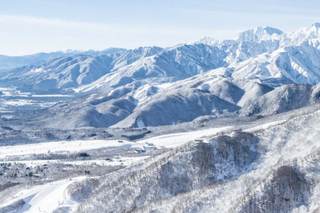

Hakuba Jigatake: the beginner-friendly side of the valley
Seven wide, gentle runs on the southern edge of Hakuba Valley, mostly beginner terrain with a few quiet tree runs up top. A relaxed pick for families and first-timers away from the Happo crowds.
Hakuba 47 and Goryu: two linked resorts on one ticket
How Hakuba 47 and Hakuba Goryu connect at the top, the terrain on each side, and who the combined area suits.

Hakuba Kashimayari: the family-friendly side of the valley
A guide to Kashimayari, a smaller Hakuba Valley resort built around families and beginners, with dedicated kids' zones and quiet slopes.

A powder day at Hakuba Cortina
Hakuba Cortina, the valley's snowiest corner and its most relaxed about tree riding.

Powder snowboarding at Hakuba Happo-One
A powder day at Happo-One, the largest of Hakuba Valley's ski areas.

Chasing deep powder in Hakuba
A powder-focused trip through Hakuba Valley's resorts in Nagano.