Facts checked 18 September 2026
We periodically re-check the facts on this page against confirmed sources. Things change fast in Japan: resorts, restaurants, runs and rental shops open, close and rename, so this is the date we last verified the claims here. This does not guarantee that every fact is accurate, but we make our best effort to keep them up to date, drawing on official sources such as the ski resort's own website.
Hakuba Valley: ten resorts on one lift pass

Image: photo by Hiroya Nakata, courtesy of Hakuba Valley (hakubavalley.com) · Image credits
Hakuba is one of only a handful of multi-resort areas in Japan. Unlike Niseko United, where all four ski areas are lift-linked into one connected mountain, Hakuba Valley's ten resorts are mostly independent, strung along a single valley road in the Northern Japan Alps and joined by shuttle bus rather than by lift: only two pairs, Hakuba 47↔Goryu and Cortina↔Norikura, actually connect at the lifts. All ten now share one lift pass, and Hakuba village sits close to the middle of them. Happo-One, the valley's biggest name and an Olympic downhill course, is minutes away; Hakuba 47, Goryu and Iwatake are a short shuttle ride, while Tsugaike Kogen, Cortina and Norikura are twenty minutes or more. It is the one base in the valley that puts you close to almost everything, at the cost of paying village prices for the privilege.
Plan a trip
- Get there
- Shinkansen Tokyo to Nagano (about 90 minutes), then a bus, roughly 70 to 80 minutes on to Hakuba. Or about four hours' drive from Tokyo.
- Then
- A genuinely workable local bus network links the village to its nearest resorts; a car adds speed and reaches Cortina, Norikura and the quieter southern resorts faster.
- Stay
- Hakuba village itself for the most central, walkable base; Iimori for the quiet end of Goryu's own lift base; Omachi, about 20 minutes' drive south, for a genuinely independent town.
- Combine
- Happo-One, Hakuba 47 and Goryu, Iwatake, Tsugaike Kogen, Cortina, Norikura, Sanosaka, Kashimayari and Jigatake: all on one pass.
- Time
- A week covers the valley's range comfortably without repeating a resort.
What one pass buys you
Most of Japan's multi-resort clusters mean choosing between two or three areas. Hakuba Valley's own all-mountain pass covers ten, from Happo-One at the big, brash end to Kashimayari and Jigatake's quiet family slopes at the southern edge. Several of the bigger names, including Happo-One, Hakuba 47, Goryu, Cortina, Norikura and Tsugaike Kogen, are also on the Epic Pass. That range is the whole appeal of a Hakuba base: instead of committing to one resort's terrain and conditions for a week, you pick a different one most mornings depending on where the snow fell overnight, who is skiing that day, or which lift line you cannot face again.
The resorts within reach
Happo-One is the valley's biggest and best-known resort, host of the downhill events at the 1998 Winter Olympics, with the steepest, most varied terrain in the valley and the crowds to match on a powder morning. Hakuba 47 and Hakuba Goryu run as one linked area next door, family-pitched and reviewed in full here: 926 metres of vertical, one of the biggest drops in Japan for a resort this mellow. Hakuba Cortina, further north and closer to the sea, takes the most snow in the valley and is the most relaxed about tree skiing; it links to Hakuba Norikura, a quieter neighbour on the same ticket. Iwatake, close to the village, is known for its mountain-top cafe and views over the valley floor; Tsugaike Kogen is wide and beginner-friendly, with one of the valley's biggest gondolas. At the southern end, Hakuba Sanosaka sits in Kamishiro, still inside Hakuba village, while Kashimayari and Jigatake lie further south towards Omachi. All three are smaller, quieter resorts built around families and first-timers, well away from the Happo crowds, and Sanosaka has wide beginner runs looking out over Lake Aoki.
Live prices and availability from Booking.com, Airbnb, Expedia and others, via Stay22. We earn a commission on bookings made through the map, at no extra cost to you; it has no bearing on what is written above.
Getting there and getting around
There is no Shinkansen station in Hakuba. The route in is the Shinkansen to Nagano, about 90 minutes from Tokyo, then a bus, roughly 70 to 80 minutes on to the village. Driving is around four hours from central Tokyo, with winter tyres and all-wheel drive expected either way. Once you are here, Hakuba is one of the few places in Japan where the local bus network genuinely works for skiers rather than just commuters, running between the village and its nearest resorts on a timetable built around lift hours. It thins out for Cortina, Norikura and the southern resorts, so a car is worth having if you plan to range across the whole valley rather than sticking close to the village.
Where to stay: three ways to base yourself
Hakuba village itself is the central option: the most walkable to the most lifts, and priced accordingly, especially around Christmas and New Year, when Hakuba draws the same international crowd as Niseko. Iimori, a short drive or bus from the village and covered in full here, is a proper town in its own right, with its own stop on the Oito Line, hotels and lodges, and a base building at Hakuba Goryu's quieter of its two lift bases, 1.4km from the main Toomi/Escal Plaza side and linked to it by the resort's free shuttle. Omachi, about 20 minutes' drive south (around 40 by train) and covered in full here, is the biggest of the three: a working town that goes properly quiet in winter, with its own restaurants and bars away from any resort-town markup, real year-round train service to Hakuba, and museums on the old Salt Road for a day off the snow. All three put you within the valley's one-pass network; the choice is really about how much you want to pay for how short a walk to the lifts.
Who this doesn't suit
If you want the single cheapest bed in the valley, Omachi undercuts Hakuba village itself, and if you have already picked one resort and have no interest in the other nine, a base right at that resort's own lifts will beat a village stay on convenience. Hakuba works best for a trip built around variety: a first visit to Japan with a mixed-ability group, or anyone who would rather choose a different mountain each morning than commit to one for a week.
Need to know
- Getting there
- Shinkansen Tokyo to Nagano (about 90 minutes), then a bus, roughly 70 to 80 minutes on to Hakuba. Or a four-hour drive from Tokyo.
- Getting around
- A genuinely workable local bus network between the village and its nearest resorts; a car for speed and for reaching Cortina, Norikura and the southern resorts.
- In range
- Happo-One, Hakuba 47 and Goryu (linked), Iwatake, Tsugaike Kogen, Cortina and Norikura (linked), Sanosaka, Kashimayari, Jigatake: ten resorts in total.
- Lift passes
- The Hakuba Valley All-Mountain Pass covers all ten. Several of the bigger resorts, including Happo-One, Goryu, 47, Cortina, Norikura and Tsugaike Kogen, are also on the Epic Pass.
- Where to stay
- Hakuba village for the most central, walkable base; Iimori for the quiet end of Goryu's own lift base (thin lodging of its own, its own Oito Line station); Omachi, about 20 minutes' drive south, for a genuinely independent town.
- Best for
- A trip built around variety: one base, ten resorts, and a genuine choice of terrain and crowd level most mornings.
Check each resort's official site for current lift, pass and opening information.
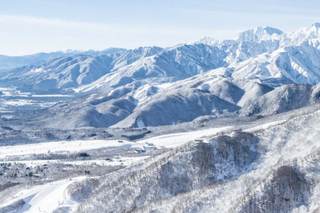

Hakuba Jigatake: the beginner-friendly side of the valley
Seven wide, gentle runs on the southern edge of Hakuba Valley, mostly beginner terrain with a few quiet tree runs up top. A relaxed pick for families and first-timers away from the Happo crowds.
Hakuba 47 and Goryu: two linked resorts on one ticket
How Hakuba 47 and Hakuba Goryu connect at the top, the terrain on each side, and who the combined area suits.
Hakuba Kashimayari: the family-friendly side of the valley
A guide to Kashimayari, a smaller Hakuba Valley resort built around families and beginners, with dedicated kids' zones and quiet slopes.

A powder day at Hakuba Cortina
Hakuba Cortina, the valley's snowiest corner and its most relaxed about tree riding.

Powder snowboarding at Hakuba Happo-One
A powder day at Happo-One, the largest of Hakuba Valley's ski areas.

Chasing deep powder in Hakuba
A powder-focused trip through Hakuba Valley's resorts in Nagano.